Trainer Handbook
Completion requirements
SESSION 5: SOCIAL SKILLS
STEP 5: Reading Social Cues
STEP 5: Reading Social Cues
Note to the trainer: Help participants recognise that disadvantaged children and children with a history of trauma may have neurologically very low “threat-perception” thresholds. Guide them to interpret the child’s aggression not as “bad manners”, but as a false alarm from the brain.
Method: Case analysis and interactive discussion.
Materials: Whiteboard and Brain States Model diagram.
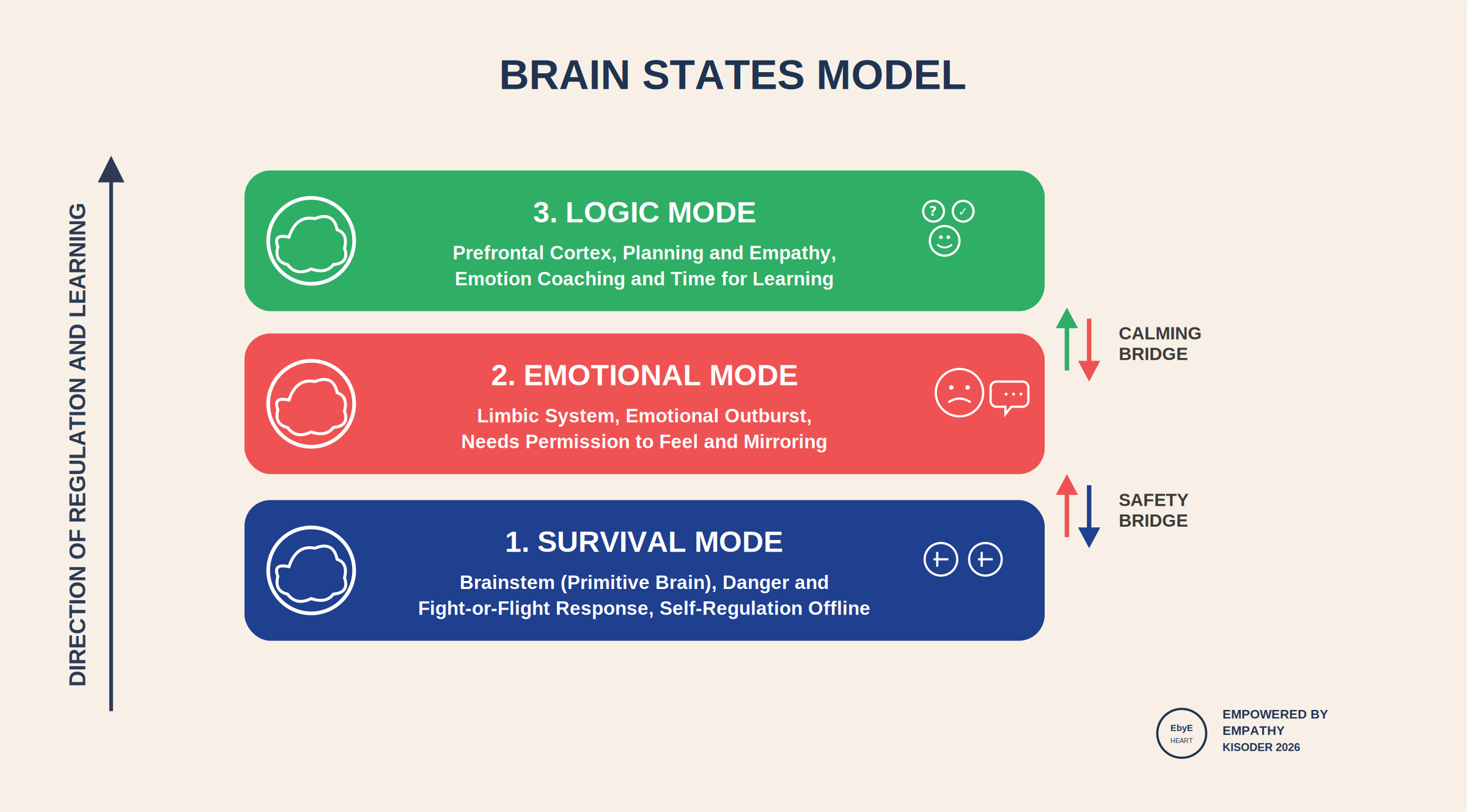
Implementation steps:
1. Analysis of social cues
“Dear colleagues, social skills are not limited to waiting for our turn, using ‘I’ language or defending our rights. A very large part of social skills is the ability to interpret correctly the invisible social signals and cues in the environment. As adults, when we enter a setting, we roughly understand what is happening through people’s gestures, facial expressions, tone of voice or whispering. However, this mechanism for reading social cues may be insufficient in the world of disadvantaged children who are under protection or who experienced neglect or violence at an early age. Because of a neurological filter, they may interpret even neutral or ambiguous signals directly as an ‘attack’ or ‘exclusion’.”
2. Presentation and in-depth analysis of the case
The trainer presents the case scenario from the handbook to the group and then begins a two-stage analysis:
Case: Can is eleven years old and is sitting in the television room. Two of his friends, Mert and Efe, are sitting on a sofa in the other corner of the room. They suddenly begin laughing while whispering quietly to one another. Can is not looking at them, but as soon as he hears the laughter, he jumps up and moves towards Mert and Efe. Clenching his fists, he shouts, ‘What are you saying behind my back? What right do you have to make fun of me?’ and throws the magazines from the coffee table towards them (Shark Strategy). In fact, Mert and Efe are speaking about a funny video they watched the previous evening, entirely unrelated to Can.
Progressive question: What Are the Neurological Reasons Why the Child Misinterprets This Social Cue?
The trainer draws participants’ attention to the Brain States Model covered in the previous module:
Chronic alarm state (hypervigilance): In the brains of children who have experienced trauma, neglect or unsafe environments, the amygdala (the alarm centre) operates continuously at the highest level. They are like a house with an excessively sensitive alarm because of the fear that a burglar may enter at any moment; the alarm sounds even when the wind blows.
Perceiving uncertainty as a threat: The whispering and laughter in the room are an “ambiguous social cue” for Can. While a healthy brain may reason, ‘I wonder what they are laughing about?’ (Logic Mode), Can’s alarm system immediately codes this uncertainty as a serious danger, an attack of exclusion or humiliation. Within seconds, the child falls into Survival Mode (the Lower Brain). The aggression (Shark Strategy) does not actually result from disrespect, but from the brain giving the command: ‘You are under attack; hit immediately to protect yourself!’
3. How Do We Teach a Child to “Read Social Cues Correctly” in Practice?
The trainer gathers participants’ suggestions through brainstorming and structures the following Three-Stage Guidance Model on the board so that caregivers can teach these cues to children such as Can:
Stage 1: First Turn Off the Alarm (Co-Regulation)
When the child is in the middle of a crisis and attacking friends, saying, ‘They were not making fun of you; you misunderstood’, will not work. First approach Can, lower yourself to his level from a safe distance and say in a calm tone, ‘Can, I am here; I am beside you. Let us take a deep breath; first you can calm down a little’, helping the child to move out of Survival Mode.
Stage 2: Examine the Social Cue (Detective Game)
When the child has calmed down and moved into the Upper Brain (Logic Mode), analyse the clues together like a crime-scene detective:
“Can, I understand that you became very angry when you heard two friends whispering and laughing in the room because you thought they were speaking about you. But did you have clear evidence that they were speaking about you? You only heard their voices, did you not? What percentage chance do you think there was that they were laughing at something completely unrelated to you? Let us investigate this like detectives.”
Stage 3: Teach the Child to Ask an “Owl Question” instead of Acting like a Shark
As a behavioural rehearsal, teach the child that when a similar ambiguous cue appears again, instead of attacking (being a Shark) or becoming offended and leaving (being a Turtle), the child can ask a question like an Owl or Fox to check the situation:
“Can, the next time someone whispers and laughs and that unpleasant feeling appears inside you, would you like to try asking directly, instead of going over and hitting them: ‘Are you laughing at something funny? May I join you?’ That is Owl behaviour. If you go and ask, you will use your own eyes to cancel the false alarm that your brain is giving you.”
Closing emphasis for the trainer
“Dear caregivers, a child in Can’s situation taking every whisper personally is not a personality disorder. Past wounds have caused these children to see the world as a dangerous place. Through our patient detective guidance, we will teach them that they do not need to remain constantly alert and that they can examine signals in the environment through an Owl’s eyes instead of immediately biting with Shark’s teeth.”