Trainer Handbook
Completion requirements
SESSION 6: ASSERTIVENESS
STEP 1: BEHAVIOUR STYLES
STEP 1: Distinguishing passive, aggressive and assertive behaviour
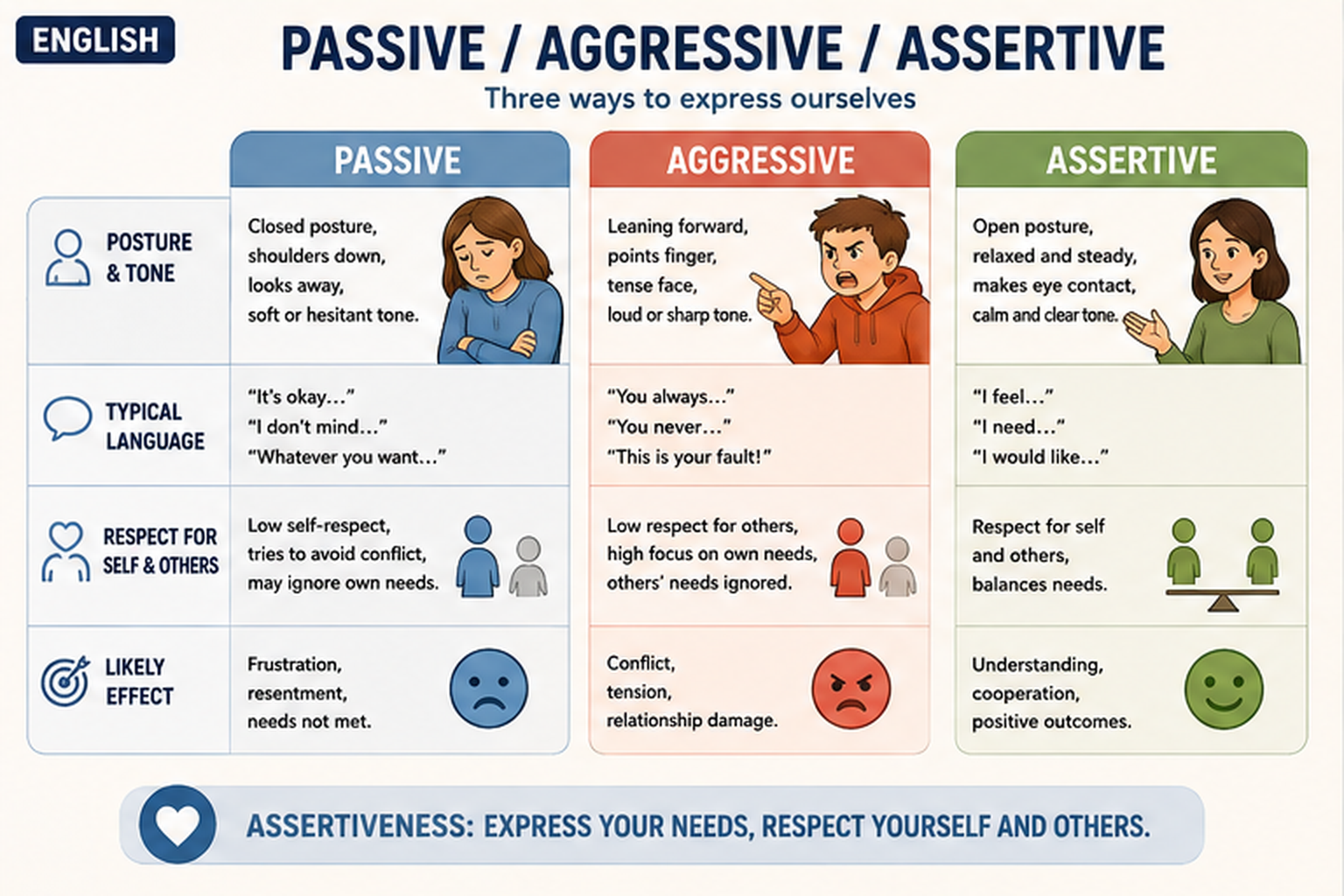
Note for the trainer: Explain the differences between passive behaviour (remaining silent), aggressive behaviour (shouting/attacking) and assertive behaviour (expressing oneself clearly and respectfully). Prevent participants from confusing assertiveness with aggressiveness. Emphasise clearly that assertiveness means both protecting one’s own rights and respecting the other person’s boundaries.
Method: Interactive presentation and enactment.
Materials: Whiteboard and cards representing four different communication styles.
Implementation steps:
“Dear colleagues, in the final module of our training we are working on emotional intelligence’s strongest shield in the outside world: assertiveness. In daily life, especially in intensive relationships within an institution, we respond to events through four main communication styles:
Passive style (I am unimportant; you are important): The person cannot state their own needs or rights. They cannot say no. They suppress their feelings and allow their boundaries to be disregarded.
Aggressive style (Only I am important; you are unimportant): When defending their rights, the person shouts, accuses and threatens, and overrides the other person’s boundaries (the Shark strategy).
Passive-aggressive style (I will not say it directly, but I will make you pay): The person smiles to your face but acts behind your back, makes insinuations, slams doors and sulks.
Assertive style (I am important, and you are important): The person expresses their rights, feelings and needs clearly and firmly without hurting or blaming the other person. This is the ideal balance that we want to develop in ourselves and foster in children.” The communication style that we display during a crisis in daily life — shouting, sulking or setting a clear boundary — is only the visible part of the iceberg: the ‘behaviour’. In psychology, however, we know that no behaviour is without a cause. Behind every behaviour lies an emotion, and behind that emotion lies a thought produced by the mind. These three elements form an inseparable triangle:
[ BEHAVIOUR TRIANGLE ]
THOUGHT
EMOTION BEHAVIOUR
Let us now analyse the passive, aggressive and assertive communication styles that we often see in the institution by placing them within this Behaviour Triangle. You will see that it is not possible to change a style without changing the underlying thought:
1. Aggressive Style Triangle (Shark)
Thought: “If I do not raise my voice, they will walk all over me; no one will listen to me. I must attack in order to prove that I am right.”
Emotion in the body: Feeling threatened, intense anger and ambition to win.
Outward behaviour: Interrupting the other person, accusing, pointing a finger, shouting or throwing objects.
2. Passive Style Triangle (Turtle)
Thought: “If I say no, they will not like me and I will be excluded. To avoid creating a problem, I must give up what I want.”
Emotion in the body: Fear of rejection, intense anxiety and a sense of worthlessness.
Outward behaviour: Remaining silent, being unable to defend one’s rights, shrinking back, being unable to say no and continually giving way.
3. Assertive Style Triangle (Owl/Fox)
Thought: “My rights and needs are valuable, and so are the rights of the person in front of me. I can express myself clearly without blaming the other person.”
Emotion in the body: Inner confidence, calmness, self-respect and respect for the other person.
Outward behaviour: Upright posture, a clear tone of voice, setting boundaries using “I” language, and protecting both oneself and the other person.
Activity: Classroom Behaviour Triangle Practice (10 minutes)
The trainer draws a very large triangle on the board and writes Thought — Emotion — Behaviour at its three corners. The trainer then gives participants the following case scenario from practice:
Scenario: “You are working the evening shift at the institution. You are very tired and, just as you are about to take a break, a colleague approaches you and says in a commanding tone, ‘Go and check that child’s room immediately; I have an urgent matter outside’, then walks away without waiting for an answer.”
The trainer invites the group to an interactive discussion:
“Dear colleagues, in response to this situation: If we unthinkingly activate the Aggressive Triangle, what thought will pass through our mind? What emotion will erupt within us, and what kind of ‘behaviour’ will we display towards our colleague? (Elicit responses such as the thought ‘They think I am a servant’, the emotion ‘Anger’, and the behaviour ‘Go and do it yourself!’.)
What happens if we activate the Passive Triangle? (Elicit responses such as the thought ‘I should not be rude’, the emotion ‘Hurt’, and the behaviour of checking the room while complaining under one’s breath.)
Our aim is to avoid both of these traps. How can we construct the Assertive Triangle in this situation? What healthy thought should we place in our mind so that our body can remain calm and we can set a clear boundary with our colleague without causing harm, but also without allowing ourselves to be disregarded?”
After receiving the responses, continue as follows:
“Excellent ideas have emerged. Let us now build together the Assertive Triangle that enables us to protect ourselves and maintain the professional relationship in this difficult situation, and write each part in its place on the board:
Corner 1: Healthy THOUGHT (mental adjustment)
To avoid falling into the traps of passivity — ‘It would be rude’ — or aggression — ‘They are trying to walk all over me’ — the assertive thought we need to place in our mind is precisely this:
“My colleague may have an urgent situation, and that is understandable; however, after a very tiring shift I also have the right to rest and to finish my shift as planned. Protecting my boundary does not mean that I am attacking my colleague or refusing to cooperate.”
Corner 2: EMOTION in the body (inner state)
The moment we place this healthy thought in our mind, the cry of the amygdala — our primitive brain — saying ‘You are under threat!’ stops. The upper brain becomes active. The emotion that emerges in the body is no longer anger or fear, but inner calmness, determination and self-respect. Our pulse does not race and our voice does not tremble.
Corner 3: Outward BEHAVIOUR (assertive boundary statement)
We have calmed down and are aware of our rights. Now we need to stop the colleague who has turned away, using firm body language — making eye contact and standing upright — without biting like a Shark or grumbling behind their back like a Turtle, and make the following Assertive Statement:
Assertive statement: “Ayşe, please wait a moment. I hear and understand that you have an urgent matter. However, I have just completed a very busy and tiring shift, my working hours are over and I need to leave immediately. For that reason, I cannot check the room. If you wish, we can inform the colleague currently on duty or our supervisor together. What do you think?”
Closing emphasis for the trainer
“In this way, we did not say ‘Yes’ to our colleague’s request and allow ourselves to be disregarded; but neither did we shout at the colleague and place ourselves in the wrong when we were in the right. We simply stood firmly and clearly behind our own boundary. This is the Assertiveness Triangle. The more we use assertiveness among ourselves and with children, the more the children in the institution will copy this clear and firm stance from us when defending their rights, instead of shouting aggressively or withdrawing passively. Through this triangle, we stop viewing children’s irritable behaviour or withdrawal simply as ‘misbehaviour’. Remember: if you want to change a child’s irritable behaviour, you must first reach the other corners of the triangle — the emotion in the child’s heart and the traumatic thought in the child’s mind — through the ‘Empathy Glasses’.”