Trainer Handbook
Completion requirements
SESSION 3: CRISIS MANAGEMENT
STEP 4: Calming Down during a Crisis
STEP 4: Calming Down during a Crisis
Note to the trainer: Analyse the 90-Second Rule and the brain states that occur during a crisis (Survival/Emotional Mode) to help prevent staff from constructing catastrophic scenarios. To prevent participants becoming lost in abstract neurological terminology, explain the brain through the metaphor of a two-storey house: a lower floor (primitive/emotional brain) and an upper floor (logical brain).
Method: Case analysis.
Materials: Brain States Model diagram.
Implementation steps:
1. Theoretical explanation: The trainer establishes the crisis situation as follows:
“Dear colleagues, as caregivers, which moments do we find most difficult in practice? The moments when a child has an anger outburst, throws objects, shouts, enters into a power struggle with you or completely rejects the rules, are they not? At such moments we generally think: ‘The child is deliberately not listening to me’, ‘The child is being disrespectful’, or ‘The child is undermining what I say’. At precisely this point, psychology and neuroscience open an important door and tell us: ‘The child is not doing it deliberately at that moment, because the child’s brain is not in logic mode!’
Let us examine step by step the three basic modes in which children’s brains - and indeed our own - operate during crises, and how we should respond to each of these modes:
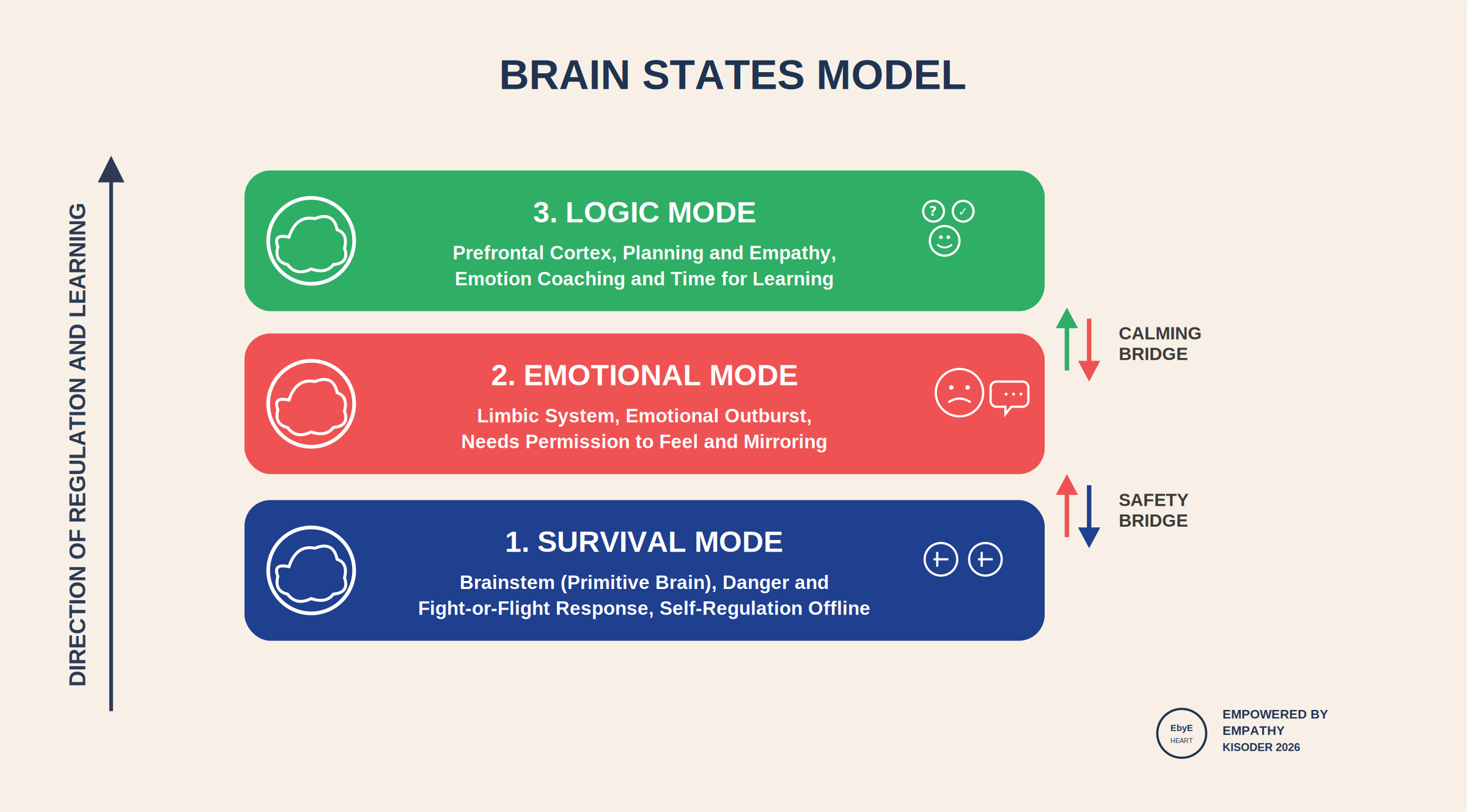
A. Survival Mode (Lower Brain - Brainstem)
Brain equivalent: This is the most primitive, lowest part of our brain. It is responsible only for safety. Like a radar, it constantly scans the surroundings and activates as soon as it detects a threat.
What does the child do during a crisis?: In this mode the child hits, breaks things, throws objects, slams doors, bites, or withdraws completely and runs from the room. Logic is largely offline. At that moment, because of the alarm in the brain, the child sees you not as a caregiver but as a ‘threat’.
The caregiver’s golden strategy: Giving advice, reminding the child of rules or imposing punishment in this mode is like adding fuel to a fire, because at that moment the child’s brain finds it very difficult to hear you. The child has only one need: physical safety. Lower your voice considerably, remain at a safe distance, approach with open palms and communicate through your body: ‘I am here; you are safe.’
B. Emotional Mode (Middle Brain - Limbic System)
Brain equivalent: This is the centre of emotions, memories and relationships. It is where the colours described in the RULER Method are experienced most intensely.
What does the child do in this mode?:The child may not be physically aggressive but may scream, cry excessively, whine or shout. The child’s statements are illogical:
The child constructs catastrophic scenarios such as ‘Everyone hates me!’ or ‘I am the worst child in this institution!’ • The caregiver’s golden strategy: The child’s only need in this mode is to be seen and heard. Do not enter into an argument about who is right or wrong. Use the RULER mirroring technique: ‘You feel very hurt and unfairly treated right now; I hear you.’ As soon as you validate the emotion, the brain begins to move towards the bridge to calmness.
C. Logic Mode (Upper Brain - Prefrontal Cortex)
Brain equivalent: This is the most developed, uppermost part of our brain. Logical thinking, problem-solving, delayed gratification, empathy and compromise all take place here.
What does the child do in this mode?:The child is calm (in the green zone), follows the rules, can use the Turtle Technique, acknowledge a mistake and cooperate with you.
The caregiver’s golden strategy: Emotion coaching takes place precisely in this mode. Solving problems, discussing rules and asking the child, ‘What could you do next time?’ work only when the child is in this mode.
Trainer’s Question and Case Analysis (15 Minutes)
After making this explanation, the trainer asks participants the following key question:
“Colleagues, the greatest trap we fall into in practice is this: when the child is in ‘Survival’ or ‘Emotional’ mode - in other words, downstairs - we try to respond from ‘Logic’ mode - upstairs. When a child is kicking the coffee table in the sitting room and we say, ‘According to the institution’s rules, damaging property is forbidden; you will be punished’, what are we doing? We are shouting down from upstairs to a child who is downstairs. Can the child hear us? No. Now think of a crisis you experienced during yesterday’s shift. In which mode was the child’s brain during that crisis? And from which mode did you approach the child? Let us analyse this through a case.”
2. Self-talk activity: Write a real crisis from an institutional setting (a case) on the board.
Participants analyse how they could move the brain into problem-solving mode during the crisis by saying silently or aloud: “I feel very disappointed right now; I can calm down; this situation will settle after 90 seconds.”
Summary Note for the Trainer:
“According to some researchers, when anger is triggered, the first physiological wave of the emotion may last about 90 seconds. If we do not feed the anger with negative thoughts such as ‘The child never listens to me’, the wave will pass. When the child is in survival mode (hitting/breaking), the child cannot hear us and first needs to feel safe through our calmness. Our rule as caregivers is clear: first Regulate (Calm), then Connect (Understand), and only then Evaluate/Teach (Logic). Trying to teach rules before the child has calmed down and moved upstairs into Logic mode is like trying to teach someone to swim in a stormy sea. We must first bring the child to shore.”